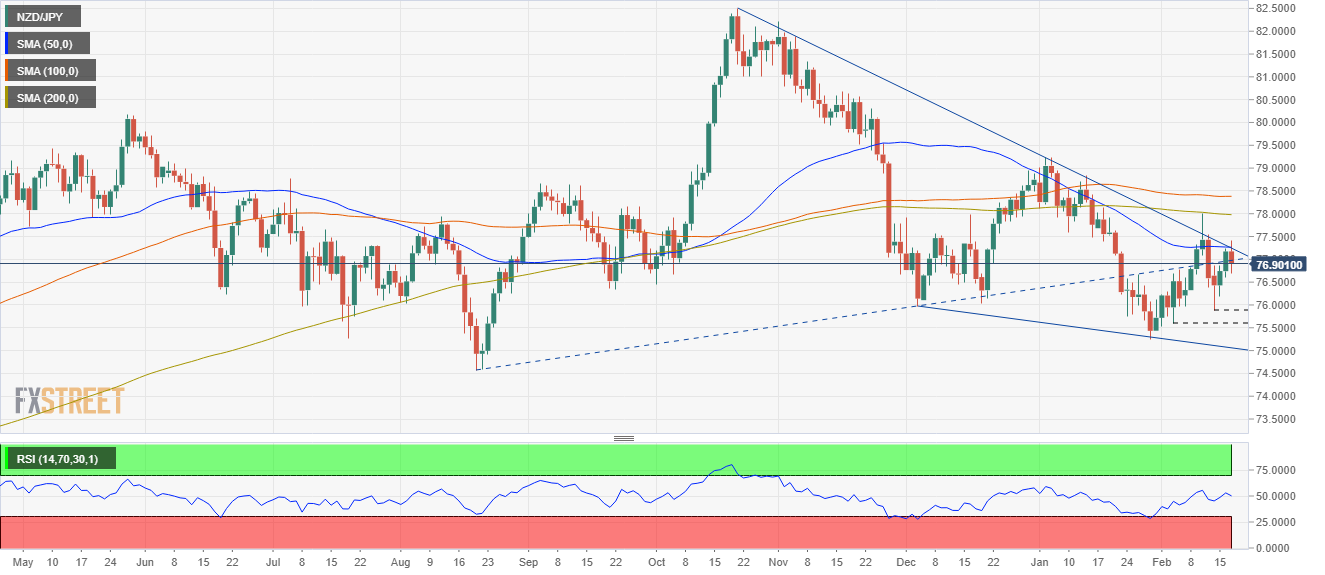
NZD/JPY Price Analysis: Failure at the 50-DMA and 77.00 exacerbated the fall towards 76.80s
- The NZD/JPY advances so far in the week 0.27% amongst a risk-off market mood.
- Risk-sensitive currencies depreciate as investors scramble towards safe-haven assets but the US dollar.
- NZD/JPY is neutral-downwards after printing a daily close below 77.00.
The NZD/JPY, one of the barometers of market mood in the FX space, drops 0.25% in the North American session among increasing tensions between Russia and Ukraine. At the time of writing, the NZD/JPY is trading at 76.90.
The financial market mood is downbeat, portrayed by US equities remaining in the red. In the FX complex, risk-sensitive currencies like the NZD, the AUD, and CAD fall, while safe-haven peers rise.
On Thursday, the NZD/JPY was headed for a third consecutive day of gains, but headlines from Eastern Europe sent the pair on a free-fall from 77.38 to 76.69, a 70 plus pip fall. Since then, the NZD/JPY seesawed between the daily pivot and the February 16 daily high at 76.96-77.20 before printing five consecutive 1-hour candlesticks below 77.00.
NZD/JPY Price Forecast: Technical outlook
Timeframe: Daily chart
The NZD/JPY is neutral biased but tilted downwards, now that the exchange rate is under the 50-DMA, leaving all the DMAs above the spot price. Furthermore, a seven-month-old upslope trendline, broken upwards, turned resistance, as the NZD bulls could not reclaim 77.00, reinforcing the bias.
Therefore, the NZD/JPY first support level would be the 76.60 psychological figure. Breach of the latter would expose the February 14 daily low at 75.87, followed by February 3 75.59.