
New Zealand Dollar strengthens against USD after Nonfarm Payrolls
- New Zealand Dollar rises versus the US Dollar following the release of US employment data.
- US Nonfarm Payrolls rose higher than expected in February, but gains were offset by wage and unemployment data.
- Hourly Earnings fell from what was expected, and the Unemployment Rate unexpectedly rose, suggesting underlying labor market weakness.
The New Zealand Dollar rises against the US Dollar on Friday, after the release of US Nonfarm Payrolls data suggests disinflationary tendencies that could bring forward the time of the Federal Reserve’s (Fed) first expected interest rate cut.
NZD/USD – the number of US Dollars that one New Zealand Dollar can buy – rose to day’s high of 0.6218 on Friday, during the US session, following the release of the Bureau of Labor Statistics (BLS) report. If the data prompts an earlier rate cut from the Fed, it will be negative for the US Dollar as lower rates attract less foreign capital inflows.
New Zealand Dollar prints new high after Nonfarm Payrolls
Whilst the headline NFP figure showed the economy adding 275K jobs in February, which was higher than the 200K expected, the other data in the BLS report suggested weaknesses in the labor market.
Average Hourly Earnings, which are a key component of inflation, rose by a lower-than-expected 4.3% YoY and 0.1% MoM. Both were below the 4.4% and 0.3% predicted. The Unemployment Rate, meanwhile, rose to a higher-than-expected 3.9% when it had been projected to stay put at 3.7%.
The data suggests less inflationary pressure from wages and low unemployment, which could prompt the Fed to bring forward interest rate cuts to earlier in the year. Lower interest rates are negative for the US Dollar as they reduce foreign capital inflows.
New Zealand Dollar supported by Brighter outlook for China
The New Zealand Dollar (NZD) has been further supported by the release of better-than-expected trade data from its largest export partner, China, on Thursday.
The Chinese Trade Balance data showed an unexpected rise in the country’s trade surplus to $125.16 billion in February, according to data from the General Administration of Customs for the People’s Republic of China.
Economists had expected the Trade Balance to come out at only $103.70 billion, from a lower $75.34 billion in the previous month of January.
The higher surplus is a sign of economic health and suggests greater prosperity, leading to increased demand for New Zealand exports, primarily milk and dairy products. This, in turn, is likely to result in an increase in demand for New Zealand’s currency.
Technical analysis: NZD/USD rising in a range
NZD/USD is trading plum in the middle of a sideways consolidation that has lasted for over a year. The long-term trend is too opaque to guess, suggesting little overall directional bias.
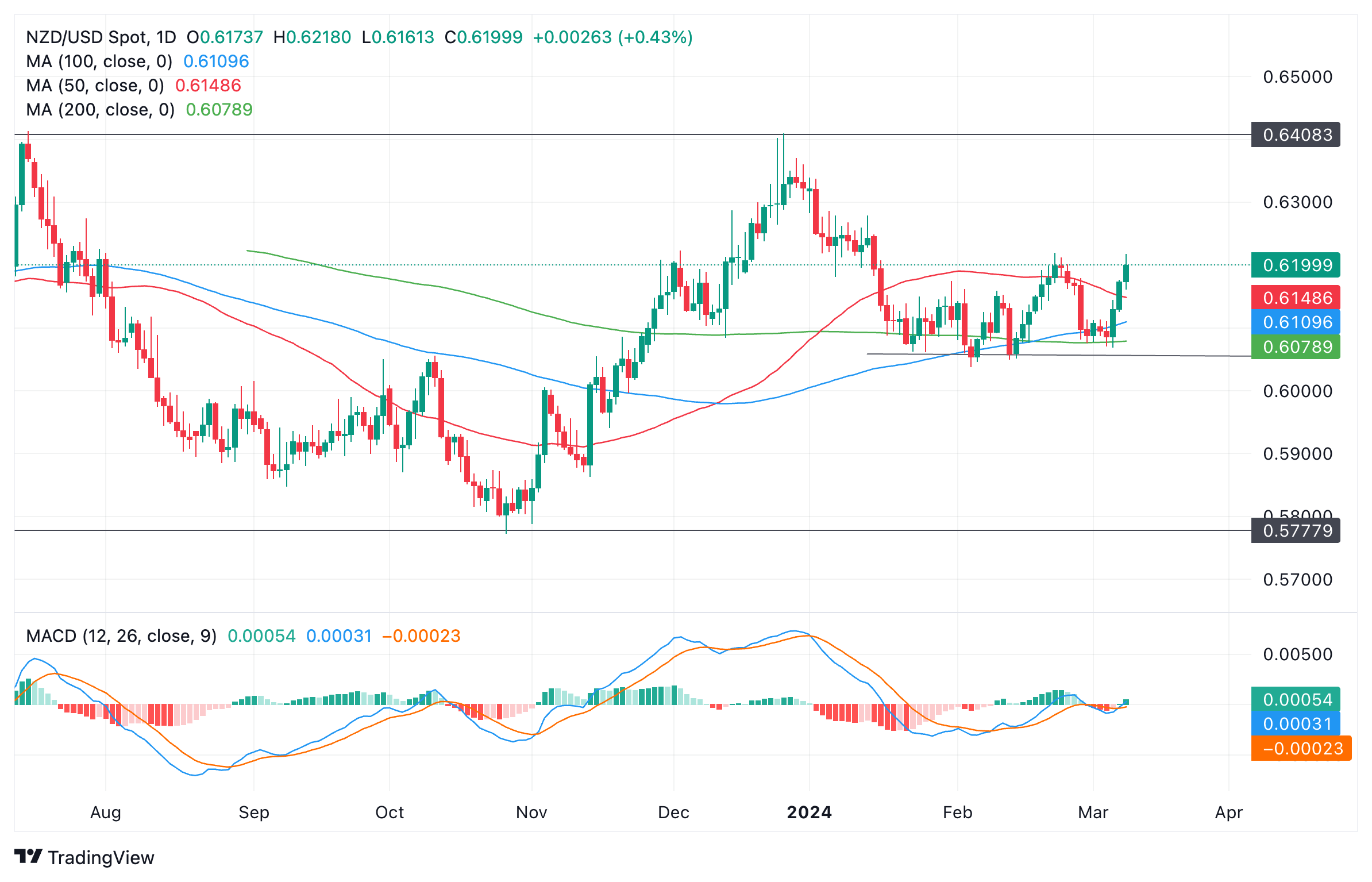
New Zealand Dollar vs US Dollar: Daily chart
The top of the range lies at 0.6400, with only a break above indicating a bullish trend developing. The range bottom – if one can be deduced amongst all the ups and downs – lies near 0.5800. Price would need to sink to below this level to turn the trend bearish.
Since Wednesday, price has bounced back from support at the level of the 100 and 200-day Simple Moving Averages (SMA) acting in concert near 0.6090. Although the recovery has been strong, it is not enough to deduce that a short-term uptrend is in play.
If Friday (today) ends as a green up day, a bullish Three White Soldier Japanese candlestick pattern will have formed, suggesting a greater chance of a bullish continuation. However, given the generally sideways nature of the pair, even such a pattern might not be so reliable unless accompanied by a key shift in fundamentals.